CASE STUDY 03
Designing AI-Assisted Customer Experiences.
Leading UX design for conversational journeys that help customers add a line and upgrade their mobile devices.
Role
Design Lead
Scope
UX strategy → implementation QA
Deliverables
User flows · wireframes · prototypes
Overview
Two journeys, owned end to end.
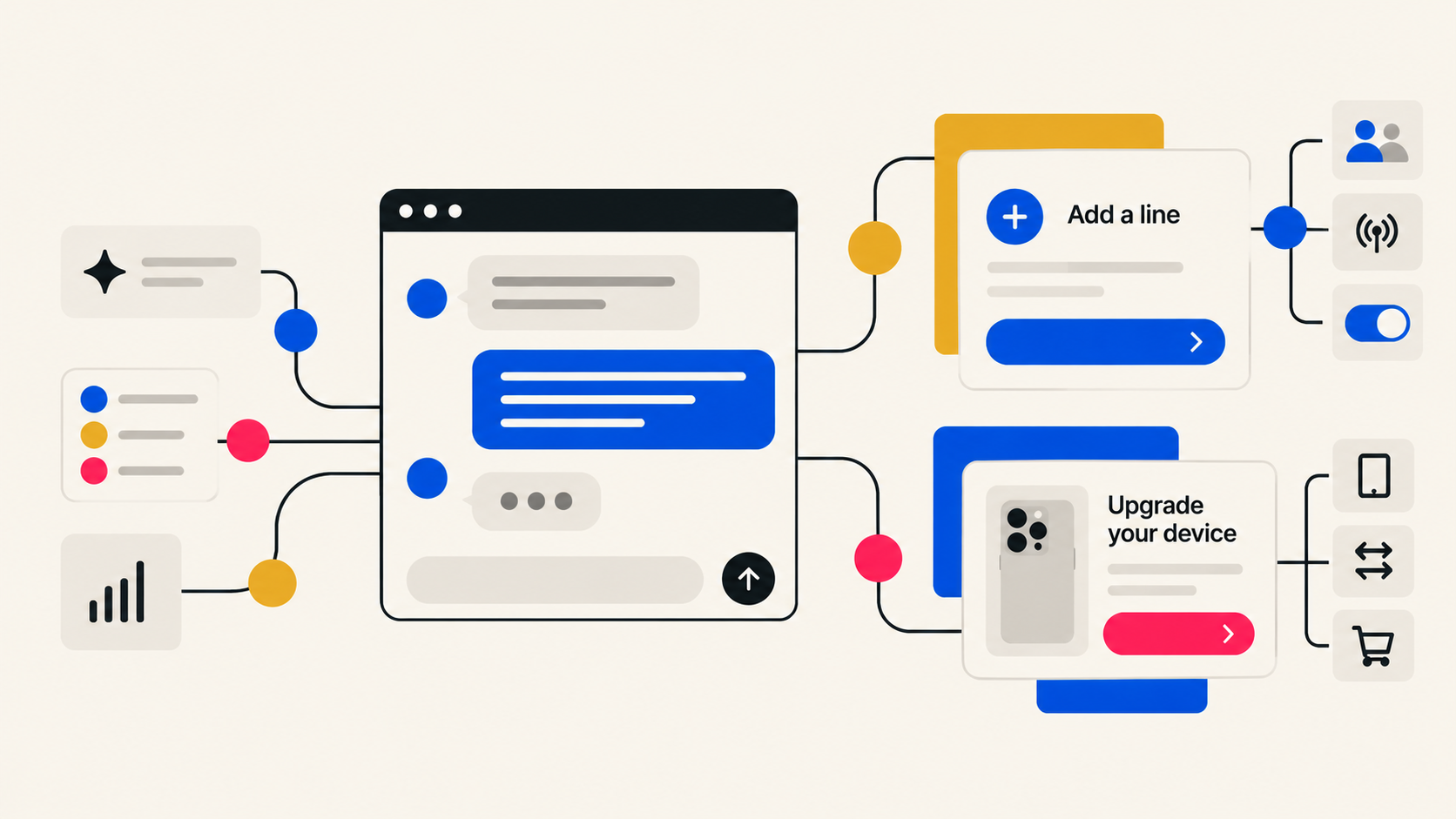
Fusion introduced a generative AI chat experience that enabled customers to navigate wireless transactions through natural conversation. As Design Lead and primary designer, I owned the end-to-end UX design for two key customer journeys: Add a Line and Mobile Upgrades.
From mapping conversational flows and developing high-fidelity designs to prototyping interactions and validating development work, I led both experiences from initial design through production implementation. I partnered with cross-functional teams to balance customer needs, business requirements, and technical constraints while supporting the transition from Andi to Fusion.
The Challenge
Conversations don't follow a straight line.
Designing for generative AI meant rethinking how customers navigate complex wireless transactions. Unlike traditional linear interfaces, conversational experiences must accommodate natural language, varied customer intents, and multiple paths toward a shared goal.
The work also involved tight timelines, evolving business requirements, and a transition between two products with distinct design systems. Maintaining consistency while adapting existing patterns to Fusion's new AI-assisted experience required close attention to both the customer journey and the underlying interface components.
The goal was to create intuitive, cohesive experiences that made complex transactions easier to navigate while meeting business objectives and maintaining design quality through implementation.
My Approach
Four stages, one throughline.
As the primary designer for both journeys, I led the work from early exploration through production QA, owning the design process and ensuring that the intended experience carried through to development.
01
Designing conversational journeys
I mapped and designed the Add a Line and Mobile Upgrade flows, translating complex wireless transactions into conversational experiences that supported customers communicating naturally with AI. I developed user flows and wireframes to define the journeys, interaction patterns, and key decision points.
02
Translating strategy into detailed designs
I created high-fidelity Figma designs and interactive prototypes to bring both journeys to life. This work helped communicate interaction intent, explore conversational patterns, and align cross-functional partners around the proposed experience.
03
Navigating the transition from Andi to Fusion
I worked through the challenges of evolving from Andi to Fusion, aligning business requirements and interaction patterns while accounting for the differences between their design systems. I focused on maintaining consistency and using the appropriate components as the new experience took shape.
04
Protecting design quality through production
My involvement extended beyond design handoff. As development progressed, I tested the implemented experiences, reviewed the work for quality, and verified that the correct design-system components were being used. This helped identify implementation inconsistencies and ensured the production experience stayed aligned with the intended designs.
The Outcome
Both journeys in production.
Both the Add a Line and Mobile Upgrade journeys were in production by the time I left the project. I had led their design from initial user flows through high-fidelity designs and interactive prototypes, then supported implementation by testing the development work and validating component usage.
The result was a cohesive design direction for two important AI-assisted customer journeys, supported by hands-on design leadership throughout the product development lifecycle.
Key Takeaway
Design integrity through to production.
Designing AI-assisted experiences requires more than creating a conversational interface. It means structuring flexible interactions around real customer needs, aligning business and technical requirements, and maintaining design integrity as ideas become production experiences.
Fusion gave me the opportunity to lead two complex customer journeys end to end, bridging conversational UX, evolving design systems, and implementation quality.